How Long Until 2:30? Easy Countdown Guide for AM and PM
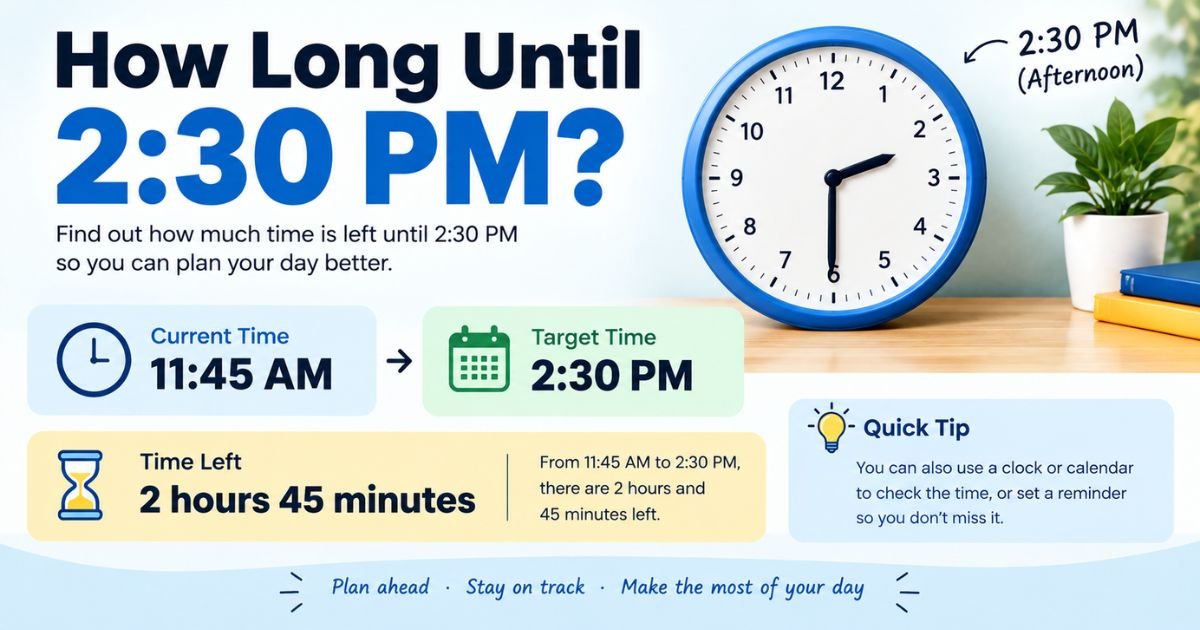
You find how long until 2:30 by subtracting the current time from 2:30. If it’s 1:00 PM, you wait 1 hour and 30 minutes. If it’s 11:00 AM, you wait 3 hours and 30 minutes.
The exact answer depends on your clock, your time zone, and whether you mean AM or PM. This guide covers the math, minutes, seconds, decimal hours, 24-hour time, midnight crossings, US time zones, and reminders.
How Long Until 2:30 Right Now?
The time left depends on what your clock shows at this moment. Check it, then match it to the table below for a fast answer to how long until 2:30 PM.
| Current Time | Time Until 2:30 PM |
| 8:00 AM | 6 hours 30 minutes |
| 9:00 AM | 5 hours 30 minutes |
| 10:00 AM | 4 hours 30 minutes |
| 11:00 AM | 3 hours 30 minutes |
| 12:00 PM | 2 hours 30 minutes |
| 12:30 PM | 2 hours |
| 1:00 PM | 1 hour 30 minutes |
| 1:30 PM | 1 hour |
| 2:00 PM | 30 minutes |
| 2:15 PM | 15 minutes |
| 2:25 PM | 5 minutes |
Your time isn’t listed? Don’t worry. The next section shows you how to work it out in seconds.
Is 2:30 AM or PM?
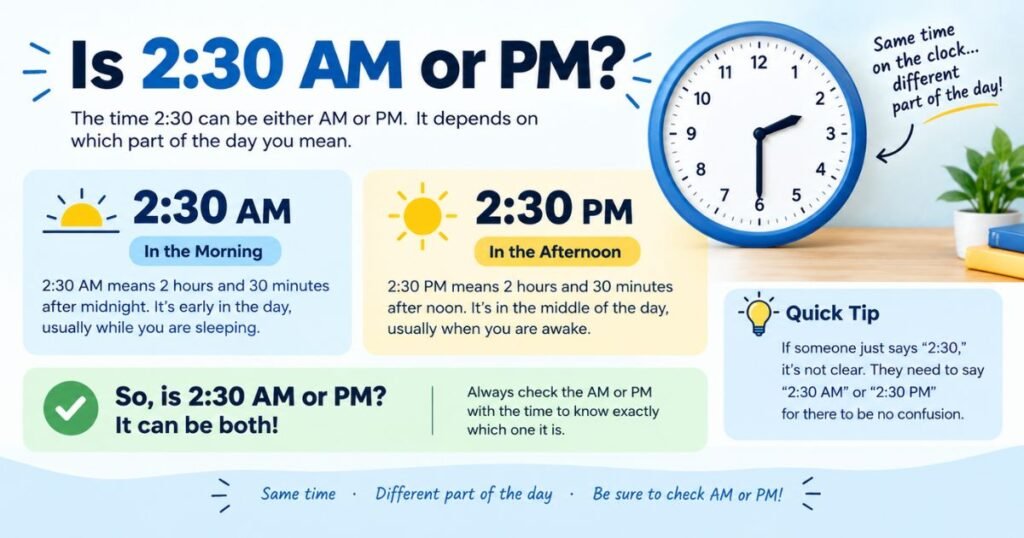
Most people who search this phrase mean 2:30 PM, the middle of the afternoon. Still, 2:30 AM exists too. It falls deep in the night, long before sunrise.
Context usually settles it. A meeting, class, or lunch break points to PM. A flight, an overnight shift, or a scheduled update might point to AM. When you write it down, always add the letters. That one habit prevents a lot of confusion.
How to Calculate the Time Until 2:30
Subtract the current time from 2:30 PM, using hours and minutes separately. Borrow one hour when the minutes don’t line up.
Here are the steps:
- Write your current time.
- Write 2:30 PM as your target.
- Subtract the hours.
- Subtract the minutes.
- If the minutes go negative, borrow 60 from the hours.
Try a real example. It’s 10:45 AM. From 10:45 to 2:30 is a tricky gap because 45 is bigger than 30.
Count in two hops instead. From 10:45 AM to 12:00 PM is 1 hour 15 minutes. From 12:00 PM to 2:30 PM is 2 hours 30 minutes. Add them and you get 3 hours 45 minutes.
Another trick works well. Jump to the next full hour first, then add the rest. It keeps your brain from tripping over the 60 minute rule.
What If It Is Already Past 2:30?
If 2:30 has already passed today, the next one arrives tomorrow. You count the hours left until midnight, then add the hours from midnight to 2:30.
Say it’s 3:00 PM now. You have 9 hours until midnight. Then you need 14 hours 30 minutes more to reach 2:30 PM. Together that’s 23 hours 30 minutes.
A shortcut helps here. Take 24 hours and subtract how far past 2:30 you are. At 3:00 PM you’re 30 minutes past. So 24 hours minus 30 minutes gives 23 hours 30 minutes.
| Current Time | Time Until Next 2:30 PM |
| 3:00 PM | 23 hours 30 minutes |
| 4:45 PM | 21 hours 45 minutes |
| 6:00 PM | 20 hours 30 minutes |
| 9:00 PM | 17 hours 30 minutes |
| 11:00 PM | 15 hours 30 minutes |
How Many Minutes Until 2:30?
Multiply the hours by 60, then add the leftover minutes. That’s the whole formula.
Suppose you have 1 hour 30 minutes left. One hour is 60 minutes. Add 30 and you get 90 minutes.
Here are more quick conversions:
- 30 minutes left equals 30 minutes.
- 1 hour left equals 60 minutes.
- 2 hours 30 minutes left equals 150 minutes.
- 4 hours 30 minutes left equals 270 minutes.
- 6 hours 30 minutes left equals 390 minutes.
Minutes work best for short waits. They feel more precise than a vague “about an hour.”
How Many Seconds Until 2:30?
Take the total minutes and multiply by 60 to get seconds. Each minute holds exactly 60 seconds.
With 90 minutes left, the math is 90 times 60. That equals 5,400 seconds. With 45 minutes left, you get 2,700 seconds. With 30 minutes left, it’s 1,800 seconds.
Most people never need seconds. Developers, event hosts, and launch teams sometimes do. A countdown timer on a screen often runs in seconds for that reason.
How Many Hours Until 2:30?
Convert the leftover minutes into a fraction of an hour to get decimal hours. Divide the minutes by 60.
This matters for timesheets, billing, and spreadsheets. A tool may want 1.5 hours instead of “1 hour 30 minutes.” Here’s the trap that catches many people. One hour and thirty minutes is 1.5 hours. It is not 1.30.
| Current Time | Time Left | Decimal Hours |
| 8:00 AM | 6 hours 30 minutes | 6.5 |
| 10:15 AM | 4 hours 15 minutes | 4.25 |
| 12:00 PM | 2 hours 30 minutes | 2.5 |
| 1:00 PM | 1 hour 30 minutes | 1.5 |
| 1:45 PM | 45 minutes | 0.75 |
| 2:00 PM | 30 minutes | 0.5 |
| 2:20 PM | 10 minutes | About 0.17 |
What Is 2:30 in 24-Hour Time?
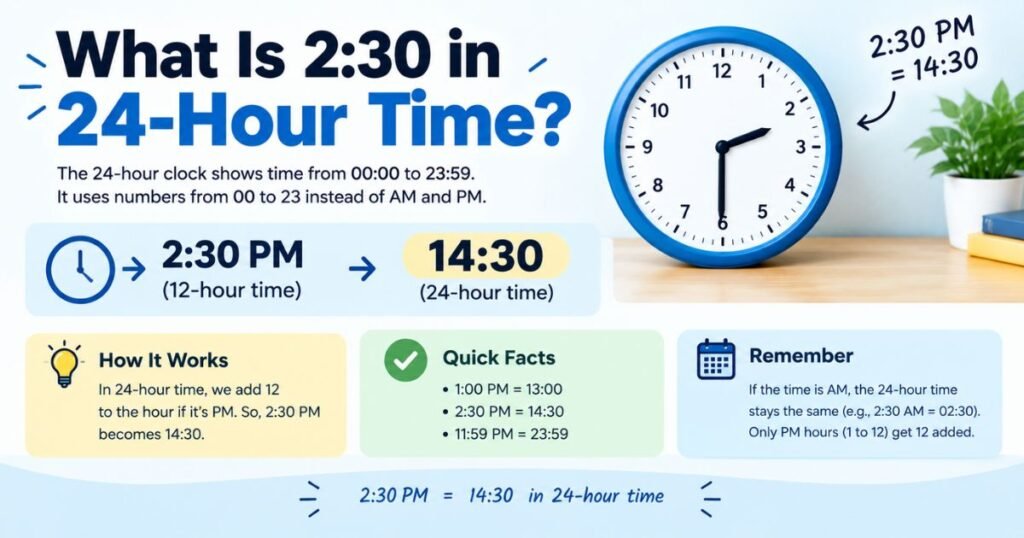
In 24-hour time, 2:30 PM is 14:30 and 2:30 AM is 02:30. For any PM hour, add 12 to the hour.
So 2 plus 12 gives 14. The minutes stay at 30. Military time and many schedules abroad use this format. Train timetables, hospital shifts, and airline tickets often do too.
The 24-hour clock removes the AM and PM guesswork. If you see 14:30, no one wonders about the afternoon. It’s settled.
You may also like this: How Long Until 3:15 PM: Quick Answer and Full Time Guide
How Long Until 2:30 AM?
To reach 2:30 AM, count the time until midnight, then add 2 hours 30 minutes. From any evening hour, the wait stays short.
Take 11:00 PM. You have 1 hour until midnight. Add 2 hours 30 minutes and the total is 3 hours 30 minutes.
| Current Time | Time Until 2:30 AM |
| 6:00 PM | 8 hours 30 minutes |
| 9:00 PM | 5 hours 30 minutes |
| 11:00 PM | 3 hours 30 minutes |
| 12:00 AM | 2 hours 30 minutes |
| 1:00 AM | 1 hour 30 minutes |
| 2:00 AM | 30 minutes |
Night owls and shift workers use this one a lot. So do people planning early flights or overnight downloads.
How to Calculate a Countdown Across Midnight
When the countdown crosses midnight, split it into two parts. First count to midnight. Then count from midnight to your target.
Here’s a full example. It’s 11:00 PM and you want 2:30 PM tomorrow. The first hop is 1 hour to reach midnight. The second hop is 14 hours 30 minutes from midnight to 2:30 PM. Add them and you get 15 hours 30 minutes.
Try one more. At 10:30 PM, you need 1 hour 30 minutes to reach midnight. Add 14 hours 30 minutes. The total comes to exactly 16 hours.
Always ask one simple question first. Does the target fall today or tomorrow? That answer shapes every step after it.
How Long Until 2:30 in Different US Time Zones?
When it’s 2:30 PM Eastern, it’s 1:30 PM Central, 12:30 PM Mountain, and 11:30 AM Pacific. Each zone west of Eastern sits one hour behind the last.
That gap matters for calls and webinars. Say a host announces a 2:30 PM start with no zone. Viewers across the country could show up an hour or three off.
| If It Is 2:30 PM Here | Local Time Elsewhere |
| Eastern Time | 2:30 PM |
| Central Time | 1:30 PM |
| Mountain Time | 12:30 PM |
| Pacific Time | 11:30 AM |
Daylight saving time adds another wrinkle. Most of the US moves clocks forward in spring and back in fall. A countdown made before the change can drift by an hour. Check that your device uses automatic time settings.
Global readers face bigger gaps. Pakistan Standard Time is UTC plus 5, and it has no daylight saving shift. During US daylight time, 2:30 PM Eastern is 11:30 PM in Pakistan. During US standard time, it’s 12:30 AM the next day. Writing the zone next to the time avoids every one of these mix-ups. For example, write “2:30 PM ET.”
Countdown Tools vs. Traditional Clocks
A countdown tool shows the time remaining, while a regular clock only shows the current time. That’s the core difference.
With a clock, you do the math yourself. With a countdown, the math is done for you and updates live.
| Feature | Traditional Clock | Countdown Tool |
| Shows current time | Yes | Sometimes |
| Shows time remaining | No | Yes |
| Sends an alert | Rarely | Usually |
| Handles time zones | No | Often |
| Needs manual math | Yes | No |
Phones already include timers and alarms. Smart speakers can answer “how long until 2:30” by voice. Desktop apps and browser tabs offer live counters as well. Pick the one that sits closest to where you work.
Why Waiting for 2:30 Feels Longer Than It Is
Waiting feels longer because your attention locks onto the clock. The more you watch, the slower time seems to move.
Psychologists often describe this as perceived time. A dull task stretches out. A busy, focused hour flies by. It’s the old “watched pot never boils” idea at work.
A countdown helps in a specific way. It turns a fuzzy wait into a clear number. Your mind relaxes because it knows exactly what’s coming.
Why Checking the Clock Again and Again Hurts
Constant clock checks break your focus and make the wait feel worse. Each glance restarts your sense of waiting.
Try a different approach. Look once, note the time left, then set an alert. Let the alert do the watching so your mind can rest.
Productivity Tips While You Count Down
Use the wait as a work window. A clear deadline sharpens focus better than open time does.
Build a Short Task List
Pick two or three small jobs that fit before 2:30. Write them down and cross each one off. Small wins keep momentum high.
Work in 15 Minute Blocks
Break the remaining time into 15 minute chunks. Give each chunk one clear goal. With 90 minutes left, you get six blocks. That’s plenty for a focused push.
Leave a Buffer
Finish five to ten minutes early. Meetings need setup time. Traffic and tech glitches love a tight schedule. A small cushion keeps you calm.
Common Ways People Use a 2:30 Countdown
People use a 2:30 countdown for deadlines, classes, and travel plans. It suits any task with a fixed start.
Work and Business Deadlines
Teams often set a 2:30 PM cutoff for reports, bids, or orders. Count backward from that time. Then assign finish times for each step. Many offices also hold their afternoon meetings around then.
School and Study
Students track class start times, exams, and study breaks. An afternoon lecture at 2:30 PM gives you a lunch window before it. A countdown helps you avoid rushing into class late.
Travel and Appointments
Work backward from your arrival time. If a doctor visit is at 2:30 PM and the drive takes 25 minutes, you should leave by about 1:50 PM. That includes a small buffer for parking. Flight and train schedules follow the same idea.
How to Set a Reminder for 2:30
Set your reminder earlier than 2:30 so you have time to act. Ten to fifteen minutes usually works well.
Open your phone’s clock or calendar app. Create an event at 2:30 PM. Add an alert at 2:15 PM. For important events, add a second alert one hour before.
Name the reminder clearly. “Team call at 2:30 PM ET” beats “Call.” Include the zone if others are joining. Test the alarm sound and volume once. A silent phone defeats the whole point.
Common Mistakes When Calculating How Long Until 2:30
Most errors come from four small slips. Knowing them helps you avoid wrong answers.
- AM and PM mix-ups. Counting to 2:30 AM when you meant the afternoon adds or removes 12 hours. Always check the letters.
- The 60 minute trap. Some people treat minutes like they run to 100. They don’t. An hour holds 60 minutes.
- Ignoring the date. If 2:30 already passed, the next one is tomorrow. Forgetting this gives a negative answer.
- Skipping time zones. A 2:30 PM start in another city may land at a very different local hour.
Double check any result that feels off. Add your answer back to the current time. You should land right on 2:30.
FAQ’s
How long until 2:30 PM today?
Subtract the current time from 2:30 PM. At 12:00 PM you wait 2 hours 30 minutes. If it’s past 2:30 PM, the wait runs to tomorrow.
How many minutes until 2:30?
Convert the hours to minutes and add the rest. With 1 hour 30 minutes left, you have 90 minutes.
Is 2:30 in the afternoon?
Yes, when it’s PM. 2:30 PM sits in the early afternoon. 2:30 AM is the middle of the night.
How many hours before 2:30 PM is 8:00 AM?
8:00 AM is 6 hours 30 minutes before 2:30 PM. In decimal form, that’s 6.5 hours.
What is 2:30 PM in military time?
2:30 PM is 14:30 in military time. Add 12 to the hour and keep the minutes the same.
Conclusion
Knowing how long until 2:30 comes down to one simple formula. Subtract the current time from 2:30, borrow an hour when needed, and split the math at midnight. Then convert to minutes, seconds, or decimal hours as the task demands.
Pair the math with a good reminder or countdown tool. Add the AM or PM label and the time zone every time. Do that and you’ll always know how long until 2:30, with no guesswork and no late arrivals.

Elena has 10 years of experience explaining time, countdowns, durations, time formats, and everyday scheduling questions.