

What Time Was 6 Hours Ago? A Simple Guide to Fast Time Math
Ever caught yourself staring at the clock, trying to figure out what time was 6 hours ago? Maybe you’re checking when a notification came in. Maybe you’re piecing together a timeline for work. Whatever the reason, this kind of math trips up more people than you’d think.
The good news is that calculating time 6 hours ago isn’t hard once you know the trick. It just takes a bit of practice with how clocks wrap around noon and midnight. This guide breaks it down step by step, so you can do it in your head next time, no calculator needed.
Quick Answer Table
Here’s a fast reference so you don’t have to read the whole article just to get your answer.
| If it’s currently… | 6 hours ago was… | Date change? |
| 12:00 AM (midnight) | 6:00 PM | Previous day |
| 3:00 AM | 9:00 PM | Previous day |
| 6:00 AM | 12:00 AM (midnight) | Previous day |
| 9:00 AM | 3:00 AM | Same day |
| 12:00 PM (noon) | 6:00 AM | Same day |
| 3:00 PM | 9:00 AM | Same day |
| 6:00 PM | 12:00 PM (noon) | Same day |
| 9:00 PM | 3:00 PM | Same day |
Find the time closest to your current one, and you’ve got your answer in seconds.
How Do You Calculate What Time Was 6 Hours Ago?
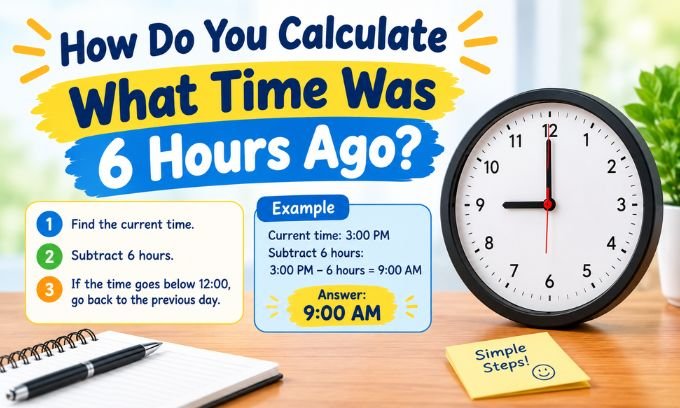
You calculate it by subtracting 6 from the current hour and adjusting for AM or PM. It sounds simple, but your brain doesn’t naturally think in 24-hour blocks. Most of us grew up using a 12-hour clock, and that format resets twice a day. This is exactly where mistakes creep in.
Here’s the basic process broken into steps.
- Look at the current time and note the hour.
- Subtract 6 from that hour.
- If the result is a positive number and you haven’t crossed noon or midnight, keep the same AM or PM label.
- If subtracting 6 pushes you past midnight or past noon, flip the AM/PM label.
- If the hour goes below 1, add 12 and move to the previous day.
Let’s walk through a real example. Say it’s currently 2:00 PM. Subtract 6, and you land on 8:00 AM. Notice the label flipped from PM to AM because you crossed the noon line. That’s the part people usually miss.
Why Does the Math Get Confusing Around Midnight?
The math gets confusing around midnight because subtracting hours can push you into the previous calendar day. This is the single biggest source of errors when doing time calculations by hand.
Picture this. It’s 2:00 AM right now. Subtract 6 hours, and you don’t just move backward on the clock. You move backward into yesterday. The correct answer is 8:00 PM the night before, not 8:00 PM today.
Here’s why this happens. A standard day only has 24 hours, and the clock resets at midnight. When your subtraction dips below zero on the hour count, you have to borrow from the day before, the same way you’d borrow a number in basic subtraction.
- Current time: 1:00 AM
- Subtract 6 hours: -5, which means you go back to 7:00 PM the previous day
That mental jump from “today” to “yesterday” catches even sharp people off guard, especially first thing in the morning before coffee kicks in.
What’s the Fastest Way to Do This Without a Calculator?
The fastest way is to use the 24-hour clock method, then convert back to 12-hour format if needed. Military time removes the AM/PM guesswork entirely, which makes quick time subtraction far less error-prone.
Here’s how that works.
- Convert your current time to 24-hour format. For instance, 3:00 PM becomes 15:00.
- Subtract 6 directly. 15 minus 6 equals 9.
- Your answer, 09:00, converts back to 9:00 AM.
If the subtraction gives you a negative number, just add 24. Say the time is 02:00. Subtract 6, and you get -4. Add 24, and you land on 20:00, which is 8:00 PM the day before.
This method skips the AM/PM flipping entirely, which is why so many pilots, nurses, and logistics workers rely on 24-hour time for scheduling. It’s less intuitive at first glance, but way more reliable once you’re used to it.
Does Your Time Zone Affect the Answer?
Yes, your time zone absolutely changes the answer, since 6 hours ago only makes sense relative to a specific location. Time itself doesn’t move at different speeds, but clocks are set differently depending on where you stand on the globe.
Here’s a practical scenario. If it’s noon in London, it’s already 6:00 AM in New York and 9:00 PM in Tokyo. Ask “what time was 6 hours ago” in each of those cities, and you’ll get three completely different answers, even though the elapsed time is identical everywhere.
This matters a lot for:
- Scheduling international calls or meetings
- Tracking when an email or message actually arrived
- Coordinating shipping and logistics across regions
- Reviewing security footage or server logs across data centers
If you’re working across time zones, always confirm which zone the “current time” refers to before you start subtracting. Skipping that step is one of the most common scheduling mistakes in remote work.
How Does Daylight Saving Time Complicate Things?
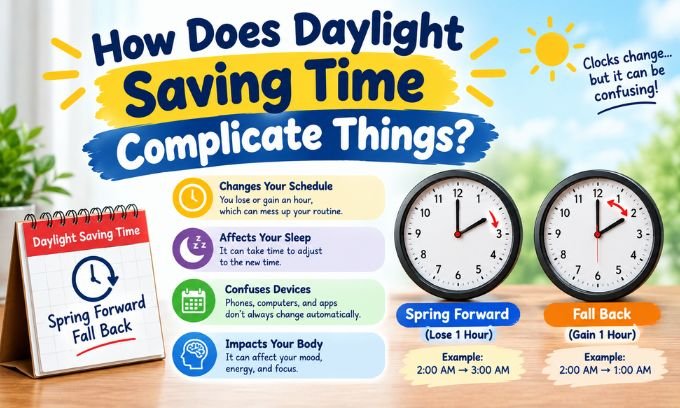
Daylight saving time complicates the math because clocks jump forward or back by one full hour twice a year. This means your usual subtraction method can be off by 60 minutes if you’re not paying attention to the calendar.
In regions that observe daylight saving, here’s what happens.
- Spring forward: Clocks skip ahead one hour, so a specific hour essentially doesn’t exist that day.
- Fall back: Clocks repeat one hour, meaning a specific hour happens twice.
If you’re calculating what time it was 6 hours ago and that window crosses one of these transition dates, your answer could be shifted by an hour unless you account for it. This trips up payroll systems, flight schedules, and even smart home devices that don’t update correctly.
The safest approach is to check whether the date in question fell on a daylight saving transition before locking in your final answer.
What Situations Actually Require This Kind of Calculation?
People need this calculation most often for scheduling, troubleshooting, and reviewing records. It shows up in more everyday situations than you might expect.
Common examples include:
- Figuring out when a text or call actually came through
- Backtracking a workout, nap, or medication schedule
- Checking server logs to see when an error first occurred
- Reviewing security camera timestamps during an investigation
- Coordinating a meeting across different offices or countries
- Calculating flight departure versus arrival windows
In fields like aviation, healthcare, and finance, this kind of precision isn’t optional. A six-hour miscalculation in medication timing or a financial transaction log can create real problems, not just minor inconveniences.
Can You Use Mental Shortcuts Instead of Full Math?
Yes, you can use anchor points like noon and midnight to shortcut the calculation without doing full arithmetic. This works well once you get comfortable with a few reference moments.
Try these shortcuts.
- If the current time is between 6:00 AM and 11:59 AM, six hours ago falls between midnight and 5:59 AM, same day.
- If the current time is between 12:00 PM and 5:59 PM, six hours ago falls between 6:00 AM and 11:59 AM, same day.
- If the current time is between 6:00 PM and 11:59 PM, six hours ago falls between 12:00 PM and 5:59 PM, same day.
- If the current time is between midnight and 5:59 AM, six hours ago falls between 6:00 PM and 11:59 PM, previous day.
Memorize these four windows, and you’ll rarely need to do the full subtraction step by step. Your brain starts to recognize the pattern after just a few tries.
What Tools Can Double Check Your Answer?
Online time calculators and your phone’s world clock feature can instantly confirm your manual calculation. These tools are especially useful when time zones or daylight saving are involved, since those variables add room for error.
Most smartphones let you add multiple cities to a world clock widget, which makes cross-checking fast. Search engines also calculate simple time math directly in the results when you type a query like “6 hours before 3 PM.”
Still, it’s worth doing the mental math yourself first. Relying only on tools means you never build the instinct, and that instinct comes in handy when you don’t have signal or your phone battery dies at the worst possible moment.
What Mistakes Do People Make Most Often?
The most common mistake is forgetting to flip AM to PM, or PM to AM, when the subtraction crosses noon or midnight. This single slip causes more wrong answers than any other part of the process.
Here are a few other errors worth watching for.
- Ignoring the date change: Subtracting hours from early morning times often lands you the day before, and people forget to note that shift.
- Mixing up time zones: Using your local time when the question actually refers to a different zone leads to answers that are hours off.
- Overlooking daylight saving: A calculation that spans a clock change day can be off by exactly one hour, which is easy to miss if you’re not checking the calendar.
- Rushing the noon crossover: Times right around 12:00 PM or 12:00 AM are the trickiest, since a tiny error there throws off the whole answer.
Slowing down for just a few extra seconds on these trouble spots saves you from having to redo the whole calculation later.
How Does This Compare to Calculating Time in the Future?
Calculating 6 hours from now uses the same logic in reverse, adding instead of subtracting. If you already know how to work backward, working forward is just a mirror image of the same steps.
For example, if it’s currently 9:00 PM, adding 6 hours brings you to 3:00 AM the next day. Just like with subtraction, the tricky part is remembering that you’ve rolled over into a new calendar day. Practicing both directions actually reinforces the skill faster, since you start to see the clock as a full loop rather than a straight line.
Frequently Asked Questions
What time was it 6 hours ago if it’s currently 5 PM?
Six hours before 5:00 PM is 11:00 AM, same day. Just subtract 6 from the hour and keep the same day since you don’t cross midnight.
Does 6 hours ago always mean the same calendar day?
No, it depends on the current time. If your current time is before 6:00 AM, six hours ago falls on the previous calendar day.
How do I calculate 6 hours ago across time zones?
Convert the current time to the target time zone first, then subtract 6 hours from that converted value. Skipping the conversion step leads to wrong answers.
Why does daylight saving time affect this calculation?
Clocks shift by one hour during daylight saving transitions, which can throw off a straightforward six-hour subtraction. Always check if the date falls near a spring or fall transition.
Is there an easier way than manual subtraction?
Yes, using 24-hour time removes the AM/PM confusion entirely and makes the subtraction more straightforward. Most online world clocks and calculators also handle this instantly.
Final Thoughts
Figuring out what time was 6 hours ago really comes down to one skill: knowing how to cross the noon and midnight lines without losing track of the day. Once that clicks, the rest is basic subtraction.
Whether you’re checking a timestamp, planning a call with someone overseas, or just settling a random debate with a friend, you now have a reliable method and a few shortcuts to fall back on. Keep the quick answer table handy, and you’ll never second guess the math again.

Elena has 10 years of experience explaining time, countdowns, durations, time formats, and everyday scheduling questions.


One Comment