How Long Until 3:15 PM: Quick Answer and Full Time Guide
Figuring out how long until 3:15 PM takes just a few seconds once you know the trick. Whether you’re counting down to a meeting, a flight, or the end of your shift, this guide breaks down the math step by step.
You’ll also learn how to handle time zone shifts, daylight saving changes, and quick mental math tricks that work for any target time, not just 3:15 PM.
Quick Answer Table
Use this table as a fast reference. Swap in your current time to see the pattern.
| Current Time | Target Time | Hours Remaining | Minutes Remaining |
| 9:00 AM | 3:15 PM | 6 hours | 15 minutes |
| 12:00 PM | 3:15 PM | 3 hours | 15 minutes |
| 1:30 PM | 3:15 PM | 1 hour | 45 minutes |
| 2:45 PM | 3:15 PM | 0 hours | 30 minutes |
| 3:00 PM | 3:15 PM | 0 hours | 15 minutes |
This table gives you a rough feel for the countdown. For your exact number, use the steps below.
How Do You Calculate the Time Until 3:15 PM
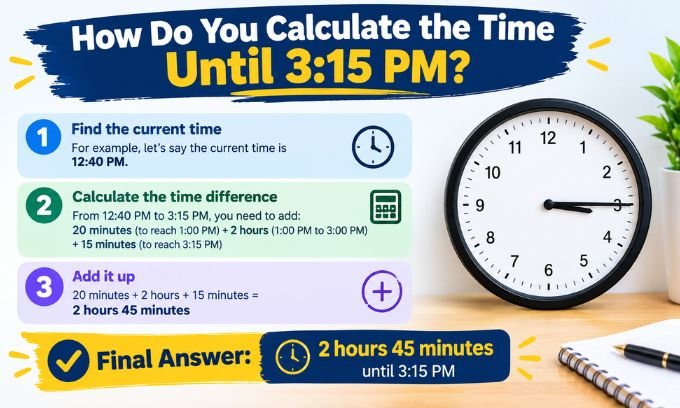
You subtract your current time from 3:15 PM using a simple two-part method: hours first, then minutes.
Here’s the process broken into clear steps.
- Write down your current time (say, 11:40 AM).
- Count the full hours between your current time and 3:00 PM.
- Add the extra 15 minutes for the 3:15 mark.
- Combine the two results for your final answer.
Using 11:40 AM as an example: from 11:40 AM to 3:00 PM is 3 hours and 20 minutes. Add the 15 minutes to reach 3:15 PM, and you get 3 hours and 35 minutes left.
This method works no matter what your starting time is. Once you get the hang of it, you won’t need a calculator.
Why Break It Into Two Steps Instead of One
Splitting the math into hours and minutes keeps you from making small counting errors. Doing the whole calculation in your head at once often trips people up, especially across the noon or midnight mark. Breaking it apart gives your brain smaller, easier chunks to handle.
What’s the Fastest Mental Math Trick for Time Countdowns
The fastest trick is rounding to the nearest hour first, then adjusting for the leftover minutes. Here’s how it plays out:
- Round your current time up to the next full hour.
- Count the hours from that rounded point to 3:00 PM.
- Add back the minutes you rounded off, then tack on the 15 minutes for 3:15.
Say it’s 1:05 PM. Round up to 2:00 PM (that’s 55 minutes rounded off). From 2:00 PM to 3:15 PM is 1 hour and 15 minutes. Add back the 55 minutes you rounded off, and the total comes to 2 hours and 10 minutes.
This shortcut feels clunky the first time you try it, but it gets fast once it’s second nature. Most people who work retail or dispatch shifts use some version of this trick without even realizing it has a name.
Does the Time Zone You’re In Change the Countdown
Yes, your time zone changes the countdown completely, since 3:15 PM means something different in every zone. A person in New York hitting 3:15 PM Eastern is nowhere near 3:15 PM for someone in Los Angeles. Keep these points in mind:
- Eastern Time is three hours ahead of Pacific Time.
- Central Time sits one hour behind Eastern and one hour ahead of Mountain.
- Mountain Time is two hours behind Eastern.
- A target time like “3:15 PM” without a specified zone usually defaults to your own local clock unless stated otherwise.
If you’re scheduling a call with someone in another zone, always confirm whose 3:15 PM you mean. This single mix-up causes more missed meetings than almost any other scheduling error.
How to Convert 3:15 PM Across US Time Zones
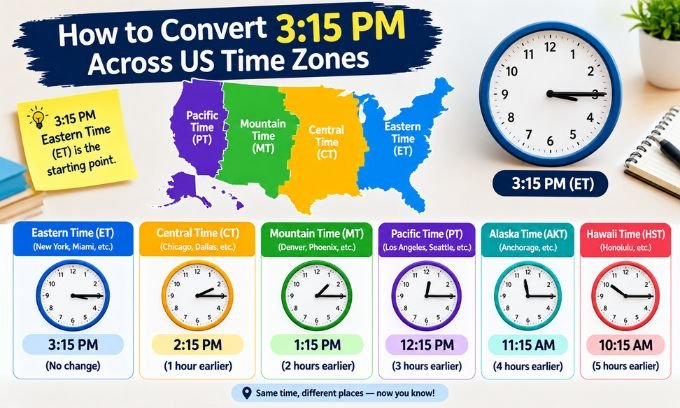
To convert, you add or subtract hours based on the zone difference. Here’s a fast reference:
- 3:15 PM Eastern = 2:15 PM Central = 1:15 PM Mountain = 12:15 PM Pacific
- 3:15 PM Central = 4:15 PM Eastern = 2:15 PM Mountain = 1:15 PM Pacific
- 3:15 PM Pacific = 6:15 PM Eastern = 5:15 PM Central = 4:15 PM Mountain
Save this list if you regularly coordinate across regions. It removes the guesswork entirely.
Does Daylight Saving Time Affect the Countdown to 3:15 PM
Daylight saving time can shift your countdown by a full hour on transition days. Twice a year, most of the US moves clocks forward or backward, and this throws off simple time math if you’re not paying attention.
- In spring, clocks jump forward, so 2:00 AM becomes 3:00 AM. Anyone counting down to an afternoon target loses an hour compared to the day before.
- In fall, clocks fall back, so 2:00 AM becomes 1:00 AM again. This adds an extra hour to your day.
- Arizona and Hawaii don’t observe daylight saving time, so their offset from other states changes twice a year even though their own clocks stay put.
If your countdown to 3:15 PM spans a daylight saving switch, double check whether the date falls before or after the transition. A calendar with the exact switch date helps avoid errors.
Read This: What Time Was 6 Hours Ago? A Simple Guide to Fast Time Math
Why Do People Search for Countdown Times Like This So Often
People search for specific countdown times because small windows matter for daily planning. A parent picking up a kid from school, an employee clocking out, or someone timing a phone call all rely on knowing exactly how much time is left. Here’s what tends to drive these searches:
- Work shifts that end at odd times, like 3:15 PM instead of a round hour.
- Appointments, especially medical or dental, that book in 15 minute increments.
- Live events or broadcasts with a fixed start time.
- Cooking or baking timers set against a clock rather than a stopwatch.
- School pickup or bus arrival windows.
Knowing the exact gap helps people plan the in-between minutes instead of just waiting around.
How Accurate Do You Need to Be When Counting Down
Your accuracy needs depend entirely on what the countdown is for. A rough estimate works fine for casual planning, but precise timing matters for anything time-sensitive.
- For a casual countdown (like waiting for a show to start), rounding to the nearest 5 minutes is plenty.
- For a work-related countdown (clocking out, meeting starts), aim for exact minute accuracy.
- For a travel countdown (flights, trains, bus departures), always build in a buffer of 10 to 15 minutes beyond your calculated time, since delays happen.
Matching your precision to the actual stakes saves you from either obsessing over seconds or showing up late.
Tools and Methods for Checking Time Until 3:15 PM
Several tools can double check your mental math if you want extra confidence. None of these require special skills to use.
- Phone clock apps often include a built in timer or countdown feature.
- Calendar apps let you set a reminder with a countdown label attached.
- Simple subtraction on paper works when you don’t have a device handy.
- Voice assistants can answer directly if you ask them the current time gap.
Whichever method you pick, cross check it against your own mental math once in a while. This keeps your own time sense sharp instead of depending fully on a device.
Common Mistakes People Make With Time Countdowns
Most countdown mistakes come from mixing up AM and PM or miscounting across the noon mark. Watch out for these specific slip ups:
- Forgetting that 12:00 PM is noon, not midnight, which throws off morning to afternoon math.
- Confusing 3:15 PM with 3:15 AM when reading a schedule quickly.
- Skipping the daylight saving check on transition weekends.
- Assuming a listed time is in your local zone when it’s actually in a different one.
- Rounding too aggressively and missing an appointment by a few minutes.
Slowing down for just a second before locking in your final number avoids nearly all of these errors.
Frequently Asked Questions
How many hours until 3:15 PM from 9 AM?
From 9:00 AM to 3:15 PM is 6 hours and 15 minutes. Count full hours first, then add the extra fifteen.
Is 3:15 PM the same as 15:15 in 24 hour time?
Yes, 3:15 PM equals 15:15 in 24 hour time. Add 12 to any PM hour before noon to get military time.
How do I calculate time until 3:15 PM across time zones?
Convert 3:15 PM to your local time zone using the correct offset, then subtract your current time from that converted value.
Does 3:15 PM change during daylight saving time?
The clock reading stays the same, but the gap to 3:15 PM can shift by an hour on transition days.
What’s the easiest way to count down to any time without a calculator?
Round your current time to the nearest hour, count hours to your target, then adjust for the minutes you rounded off.
Final Thought
Counting down to a specific time like 3:15 PM comes down to two things: knowing your current time and doing simple subtraction.
Break the math into hours and minutes, watch for time zone differences, and stay alert around daylight saving transitions. Once you’ve practiced the method a few times, you’ll be able to calculate any countdown in your head within seconds, no app required.

Elena has 10 years of experience explaining time, countdowns, durations, time formats, and everyday scheduling questions.