How Long Until 10:15? Quick Countdown and Easy Math
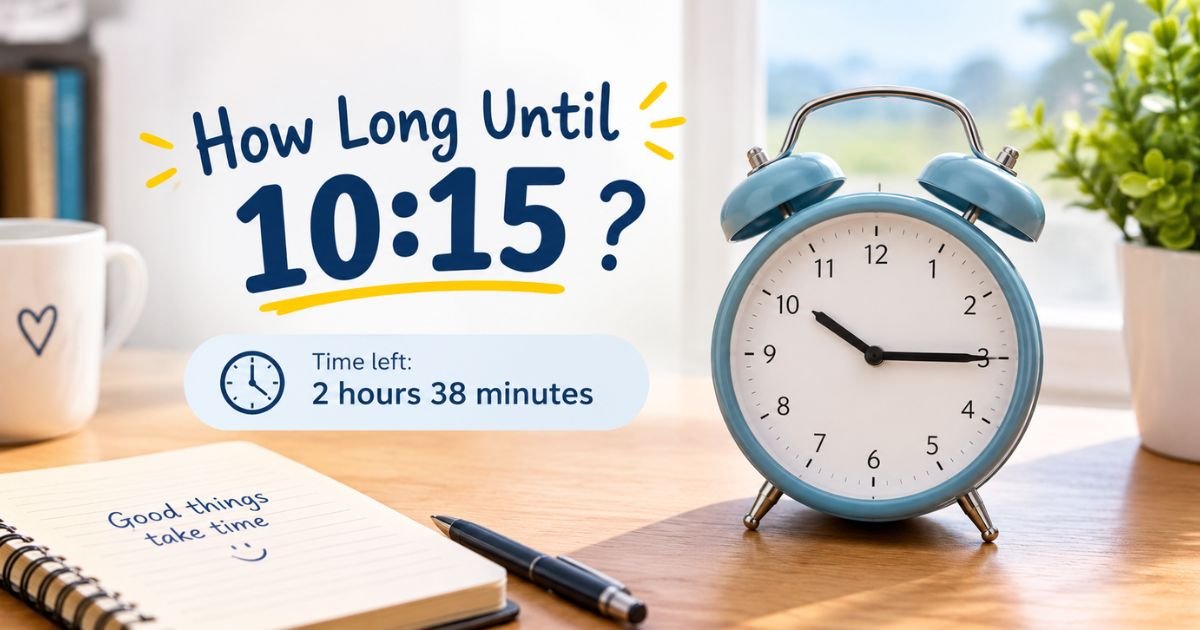
How long until 10:15 depends on the time you’re checking. At 9:00 AM, you’ve got 1 hour and 15 minutes left. At 10:00 AM, only 15 minutes remain.
This guide walks you through the simple subtraction method, minute and second conversions, next-day rollover, and time zone traps. You’ll also pick up reminder tips and a short FAQ.
How Long Until 10:15 Right Now?
The answer is 10:15 minus your current time. No page can read your clock, so this table covers the most common starting points for a 10:15 AM target.
| Current Time | Target Time | Time Remaining |
|---|---|---|
| 6:00 AM | 10:15 AM | 4 hours 15 minutes |
| 7:30 AM | 10:15 AM | 2 hours 45 minutes |
| 8:00 AM | 10:15 AM | 2 hours 15 minutes |
| 9:00 AM | 10:15 AM | 1 hour 15 minutes |
| 9:30 AM | 10:15 AM | 45 minutes |
| 10:00 AM | 10:15 AM | 15 minutes |
| 10:10 AM | 10:15 AM | 5 minutes |
| 10:30 AM | 10:15 AM (tomorrow) | 23 hours 45 minutes |
| 12:00 PM | 10:15 AM (tomorrow) | 22 hours 15 minutes |
| 3:00 PM | 10:15 AM (tomorrow) | 19 hours 15 minutes |
| 9:00 PM | 10:15 AM (tomorrow) | 13 hours 15 minutes |
| 11:00 PM | 10:15 AM (tomorrow) | 11 hours 15 minutes |
Your time isn’t listed? The next section shows you how to work it out in seconds.
How to Calculate the Time Until 10:15

You calculate the wait by subtracting your current time from 10:15. The trick is borrowing an hour when your minutes are larger than 15.
Say it’s 7:30 AM. Follow these steps:
- Write down your current time: 7:30.
- Compare the minutes. Thirty is bigger than 15, so you need to borrow.
- Rewrite 10:15 as 9 hours and 75 minutes.
- Subtract the hours: 9 minus 7 leaves 2.
- Subtract the minutes: 75 minus 30 leaves 45.
- Your answer is 2 hours and 45 minutes.
Want proof? Add 2:45 to 7:30. You land right on 10:15.
What If It’s Already Past 10:15?
You’re counting down to 10:15 tomorrow, so the wait runs close to a full day. Subtract your current time from 24:00, then add 10 hours and 15 minutes.
Take 3:00 PM, which is 15:00 on a 24-hour clock. Twenty-four minus 15 gives you 9 hours. Add 10 hours 15 minutes and you get 19 hours and 15 minutes.
Here’s a shortcut. At 10:30 AM, you’ve just missed the mark by 15 minutes. That leaves 23 hours and 45 minutes until the next one.
How Many Minutes Until 10:15?
Multiply the hours by 60, then add the leftover minutes. That single move converts any countdown into minutes.
Try 2 hours and 45 minutes. Two times 60 is 120. Add 45 and you get 165 minutes.
A few more examples:
- 4 hours 15 minutes equals 255 minutes.
- 1 hour 15 minutes equals 75 minutes.
- 23 hours 45 minutes equals 1,425 minutes.
How Many Seconds Until 10:15?
Multiply your minutes by 60 to get seconds. It’s the same pattern one step further along.
If you’re 165 minutes away, that’s 9,900 seconds. Fifteen minutes? That’s 900 seconds. For a bigger picture, 10:15 AM sits 36,900 seconds after midnight.
How Many Hours Until 10:15?
Divide the minutes by 60 to get decimal hours. This matters when you’re logging work time or filling in a spreadsheet.
| Time Now | Time Remaining | Decimal Hours |
|---|---|---|
| 6:15 AM | 4 hours | 4.0 |
| 7:00 AM | 3 hours 15 minutes | 3.25 |
| 7:45 AM | 2 hours 30 minutes | 2.5 |
| 8:00 AM | 2 hours 15 minutes | 2.25 |
| 8:30 AM | 1 hour 45 minutes | 1.75 |
| 9:00 AM | 1 hour 15 minutes | 1.25 |
Watch out for one classic trap. One hour and 30 minutes is 1.5 hours, not 1.30. Clocks run on 60, but decimals run on 100.
Read This: How Long Until 1:30? Countdown to 1:30 PM
What Is 10:15 on a 24-Hour Clock?

10:15 AM stays 10:15 in 24-hour format, and it’s written 1015 in military time. 10:15 PM becomes 22:15, or 2215.
The rule is easy. For any PM time, add 12 to the hour. That means 10 plus 12 gives you 22.
Here’s one more angle. 10:15 AM falls 615 minutes after midnight. The PM version lands at 1,335 minutes.
How Long Until 10:15 in Different Time Zones?
The countdown shifts with your zone, because 10:15 AM Eastern isn’t 10:15 AM Pacific. Always confirm which clock the event follows.
| If It’s 10:15 AM Here | Then It’s This Elsewhere |
|---|---|
| Eastern Time | Central 9:15 AM |
| Eastern Time | Mountain 8:15 AM |
| Eastern Time | Pacific 7:15 AM |
Daylight saving time adds a wrinkle. Most of the US sets clocks back one hour on the first Sunday of November. A countdown that crosses that night runs an hour longer than the clock math suggests.
Anyone who schedules calls across coasts learns this fast. Write the zone next to the time, such as “10:15 AM ET.” It prevents a lot of missed meetings.
How to Count Down Across Midnight
Count the hours to midnight first, then add the hours from midnight to 10:15. Splitting the trip into two legs keeps the math clean.
Take 11:45 PM. You’ve got 15 minutes until midnight. Add 10 hours 15 minutes and the total is 10 hours 30 minutes.
At 11:00 PM, the same method gives you 1 hour plus 10 hours 15 minutes. That’s 11 hours 15 minutes.
Calendar Alerts vs. Countdown Timers
A countdown timer shows the time left, while a calendar alert simply pings you at a set moment. Each tool solves a different problem.
| Feature | Traditional Clock | Countdown Tool |
|---|---|---|
| Shows time remaining | No, you calculate it | Yes, automatically |
| Handles midnight | Manual math | Automatic |
| Alerts you | Rarely | Alarm or notification |
| Best for | Quick glances | Deadlines and meetings |
Use both together. Set a calendar event for 10:15, then add a reminder 15 minutes earlier. That early nudge gives you room to wrap up and move.
Practical Ways People Use a 10:15 Countdown
People lean on a 10:15 countdown for meetings, classes, trains, and appointments. The goal is always the same: arrive prepared, not panicked.
Work Meetings and Deadlines
A 10:15 start often follows a 10:00 standup. Count back from the target and block your prep time first.
School and Study
Many class periods and exam sessions begin near this mark. Students who track the remaining minutes tend to pace their review better.
Travel and Appointments
Work backward from the departure or check-in time. If a train leaves at 10:15 AM, plan to reach the platform by 9:45 AM. That’s a 30-minute cushion.
Smart Ways to Use the Wait
The best way to use a short wait is to give it a job. A watched pot never boils, and a watched clock crawls.
Break It Into 15-Minute Blocks
Slice the countdown into small sprints. At 9:00 AM, finish one task by 9:15, another by 9:30, and so on.
Stop Checking the Clock
Repeated peeking makes time feel slower. Set one alert and let it do the watching for you.
Leave a Buffer
Aim to be ready at 10:05. Ten spare minutes absorb traffic, slow elevators, and last-second emails.
Common Mistakes When Calculating the Time Until 10:15
Most errors come from four habits. Spot them early and your math stays sharp.
- Mixing up AM and PM. A 12-hour gap changes everything.
- Treating minutes like decimals. Sixty minutes make an hour, not 100.
- Ignoring the date. Past 10:15 means you’re aiming at tomorrow.
- Forgetting the time zone. Always check whose clock rules the event.
Frequently Asked Questions
How long until 10:15 AM today?
Subtract your current time from 10:15. At 8:00 AM, the wait is 2 hours and 15 minutes.
How many minutes until 10:15 from 9:30 AM?
It’s 45 minutes. Half an hour gets you to 10:00, and 15 more reach 10:15.
Is 10:15 in the morning or at night?
10:15 AM is mid-morning. 10:15 PM falls at night, and it reads 22:15 on a 24-hour clock.
What is 10:15 PM in military time?
It’s 2215 hours. Add 12 to the 10 and keep the 15 minutes.
How long until 10:15 AM tomorrow from 10:30 PM?
The wait is 11 hours and 45 minutes. You’ve got 1 hour 30 minutes until midnight plus 10 hours 15 minutes after it.
Conclusion
Figuring out how long until 10:15 takes one clean move. Subtract your current time, borrow an hour when needed, and add a day if you’ve passed the mark. Convert to minutes by multiplying by 60 and you’re done.
Pair the math with a reminder and a small buffer. You’ll show up calm, on time, and ready for whatever 10:15 brings.

Elena has 10 years of experience explaining time, countdowns, durations, time formats, and everyday scheduling questions.