
How Long Until 3 PM? Quick Countdown Guide & Tricks
You glance at the clock. You wonder how much longer until 3 PM. Maybe your shift ends then. Maybe a flight leaves then. Maybe you just want the workday to be over.
Figuring out how long until 3 PM is easier than it looks. You don’t need an app. You don’t need a math degree. You just need a clear method and a few seconds.
This guide walks you through that method step by step. It also covers time zones, common scheduling traps, and quick tricks for doing the math in your head.
Quick Answer: How Long Until 3 PM Right Now
The time left until 3 PM depends entirely on your current time. Here’s a fast reference table showing common starting points and the gap to 3 PM.
| Current Time | Time Until 3 PM |
| 12:00 PM | 3 hours 0 minutes |
| 12:30 PM | 2 hours 30 minutes |
| 1:00 PM | 2 hours 0 minutes |
| 1:15 PM | 1 hour 45 minutes |
| 1:45 PM | 1 hour 15 minutes |
| 2:00 PM | 1 hour 0 minutes |
| 2:30 PM | 30 minutes |
| 2:45 PM | 15 minutes |
| 3:00 PM | You’re there |
Find your closest time on this table. That gives you a quick estimate. For an exact answer, use the calculation method below.
What Does “How Long Until 3 PM” Actually Mean
This question asks for the duration between right now and the moment the clock hits 3:00 PM. It’s a subtraction problem with a twist. Clocks don’t run on base ten. They run on sixty minutes per hour.
That twist trips people up. You can’t just subtract 1:45 from 3:00 the way you’d subtract 145 from 300. You have to think in hours and minutes separately, then combine them.
How to Calculate Time Until 3 PM
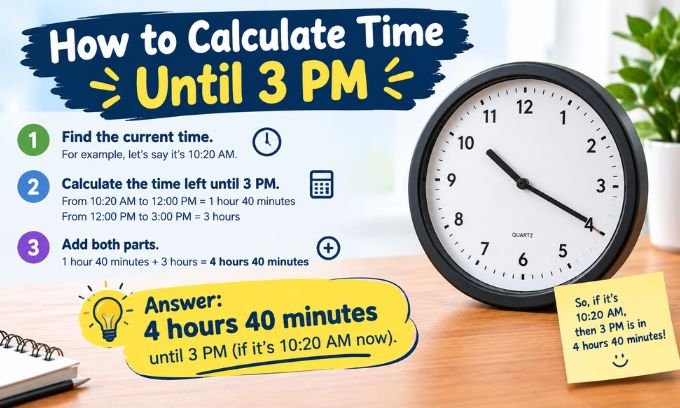
Here’s the exact process. Follow these steps and you’ll get an accurate answer every time.
- Check the current time. Look at a clock or your phone. Note the hour and minute.
- Find the hour gap. Subtract your current hour from 3. If it’s 1 PM, that gap is 2 hours.
- Adjust for minutes. If your current time isn’t on the hour, subtract those minutes from your hour total.
- Combine the result. Add the adjusted hours and minutes together for your final answer.
Example One
It’s 1:20 PM. The hour gap to 3 PM is 2 hours. Since you’re 20 minutes into the hour, subtract those 20 minutes. That leaves 1 hour and 40 minutes until 3 PM.
Example Two
It’s 2:50 PM. You’re already close. Just count forward. From 2:50 to 3:00 is 10 minutes. No complicated math needed here.
The Mental Math Trick for Crossing the Hour
Most people stumble when the current time isn’t a clean hour. Here’s a trick that fixes that.
Instead of subtracting straight across, break the gap into two smaller pieces.
- First, find how many minutes remain until the next full hour.
- Then, add the remaining full hours until 3 PM.
For instance, say it’s 1:42 PM. You need 18 minutes to reach 2:00 PM. From 2:00 PM, it’s exactly one hour to 3:00 PM. Add those together. Your total is 1 hour and 18 minutes.
This chunking method works because your brain handles small jumps better than big subtraction problems. Try it a few times and it becomes automatic.
Why People Struggle With 12-Hour Clock Math
The 12-hour clock resets twice a day. That reset point causes most of the confusion around midday calculations.
Digital clocks make this worse in some ways. You see “1:45” and your brain wants to treat that like a decimal number. It isn’t. The minutes portion caps at 59, not 99.
A 24-hour clock, sometimes called military time, avoids this problem. Under that system, 3 PM becomes 15:00. If your current time is 13:45, the subtraction is straightforward: 15:00 minus 13:45 equals 1 hour 15 minutes. Some people find switching their phone clock to 24-hour format removes the guesswork entirely.
Time Zones and Why “3 PM” Isn’t Always the Same
If you’re coordinating with someone in another city, 3 PM stops being a fixed point. It becomes a moving target based on location.
A team member in Los Angeles working toward a “3 PM deadline” set by a colleague in New York needs to know which 3 PM applies. That gap between Pacific and Eastern time is three hours. Miss that detail and you’ll show up three hours off.
Before you calculate time until 3 PM for any shared deadline, confirm these details:
- Which time zone the 3 PM refers to
- Whether daylight saving time affects either party
- If the deadline is written in local time or UTC
A quick clarifying message saves everyone a scramble later.
Practical Situations Where This Question Matters
People don’t ask “how long until 3 PM” out of idle curiosity. Usually, something specific is riding on the answer.
Catching a Flight
A 3 PM departure sounds simple until you factor in everything before it. Security lines, boarding calls, and traffic all eat into that window. If it’s noon, your three-hour cushion might really only give you fifteen minutes of actual buffer once you account for getting to the gate.
Wrapping Up a Work Shift
Many retail and office shifts end at 3 PM. Watching the clock creep toward that number is a universal experience. Knowing exactly how much time remains helps you pace your last tasks instead of rushing at the end.
Hitting a School or Appointment Pickup
Parents often work backward from a 3 PM pickup time. If it’s 1:30 PM, that’s 90 minutes to finish errands, grab gas, and get in the car line.
Managing a Countdown to a Meeting
If a call starts at 3 PM, knowing you have 40 minutes left tells you whether you have time to finish an email first or need to log in right now.
Tips for Staying Accurate When Counting Down
Small mistakes creep in when you’re rushing. These tips keep your calculation solid.
- Always confirm AM versus PM. A 3 AM deadline and a 3 PM deadline are twelve hours apart.
- Round conservatively. If you’re unsure, round down on the time you think you have left.
- Double check your source clock. Phones, wall clocks, and car dashboards can drift by a few minutes.
- Build in a buffer. Add ten to fifteen minutes of cushion for anything time-sensitive, like travel or appointments.
- Use a timer for short gaps. Once you’re under 30 minutes, a phone timer keeps you honest.
How Long Until 3 PM if You’re Starting From Midnight
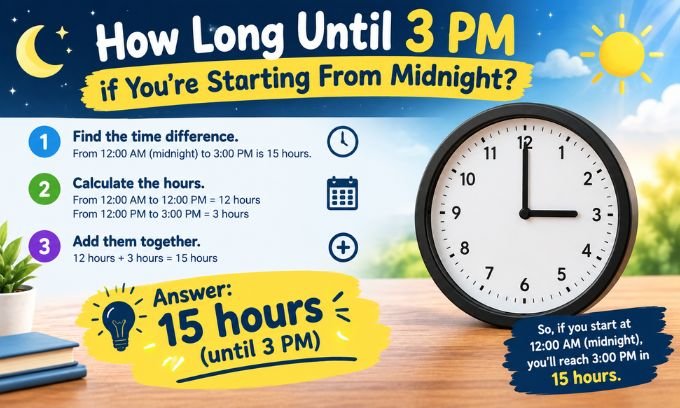
Someone planning an entire day sometimes starts the countdown from midnight instead of the current moment. That calculation looks different since it spans a full 15 hours.
From 12:00 AM to 3:00 PM is exactly fifteen hours, no minutes to adjust. This kind of full-day countdown helps with planning travel days, event schedules, or long shifts that start before sunrise.
Should You Use a Timer App or Do the Math Yourself
Countdown apps handle the calculation for you. Type in a target time and the app tracks the seconds. That’s handy when you need constant updates, like during a live event.
But manual math has its place too. You won’t always have your phone open. You might be driving, cooking, or sitting in a meeting where pulling out an app feels awkward. Knowing the mental trick means you’re never stuck.
A good approach uses both. Rely on your own quick math for a rough idea, then switch to a timer once you’re within the final ten or fifteen minutes. That combination keeps you accurate without staring at a screen the whole afternoon.
Some people also like writing the target time on a sticky note or whiteboard. Seeing “3:00 PM” visually reinforces the goal and makes the countdown feel less abstract.
How Workplaces Use 3 PM as a Benchmark
Plenty of businesses treat 3 PM as an unofficial checkpoint. It splits the standard workday roughly into two halves, especially for shifts that run from 9 to 5 or from 7 to 3.
Retail managers often use it to gauge whether the day’s sales pace is on track. Warehouse teams use it to check if the day’s shipping quota will get met. Even school staff treat it as the natural marker for dismissal prep.
Because so many routines orbit this single hour, questions like “how long until 3 PM” pop up constantly across totally different industries. Understanding the math behind it applies just as well to a cashier watching the clock as it does to a pilot checking a flight schedule.
Common Mistakes to Avoid
A few errors show up again and again when people calculate time until a set hour.
- Forgetting the 60-minute rule. Treating minutes like decimals leads to wrong totals.
- Mixing up AM and PM. This mistake causes twelve-hour errors, which is a huge miss.
- Ignoring time zones on shared deadlines. A “3 PM” without context can mean three different things to three different people.
- Not accounting for daylight saving shifts. Clocks moving forward or back can quietly throw off multi-day plans.
Catching these early keeps your countdown accurate and your plans on track.
Frequently Asked Questions
How do I calculate how long until 3 PM from any time?
Subtract your current hour from 3, then adjust for the minutes past your current hour. Combine both numbers for your total wait time.
Is 3 PM the same everywhere in the world?
No. 3 PM shifts depending on time zone, so always confirm whether a deadline uses local time or a specific zone like UTC.
What’s an easy trick for tricky times like 1:42 PM?
Find the minutes needed to reach the next full hour, then add the remaining hours until 3 PM. This chunking method avoids messy subtraction.
How many hours is it from midnight to 3 PM?
It’s exactly 15 hours, since 3 PM falls fifteen hours after midnight on a standard clock.
Why do people get confused calculating time on a 12-hour clock?
The 12-hour clock resets at noon and midnight, which makes straight subtraction unreliable. Switching to 24-hour time removes that confusion entirely.
Conclusion
Counting down to 3 PM doesn’t need to be complicated. Check the current time, find the hour gap, adjust for minutes, and you’re done. Whether you’re racing to catch a flight, closing out a work shift, or just watching the clock until the day winds down, this simple method gets you an accurate answer fast.
Keep the mental math trick in your back pocket for messy times like 1:42 or 2:17. Break the gap into a jump to the next hour, then add what’s left. It turns a confusing subtraction problem into two easy steps.
Next time someone asks how much time is left until 3 PM, you’ll have the answer before they finish the question.

Elena has 10 years of experience explaining time, countdowns, durations, time formats, and everyday scheduling questions.
One Comment