
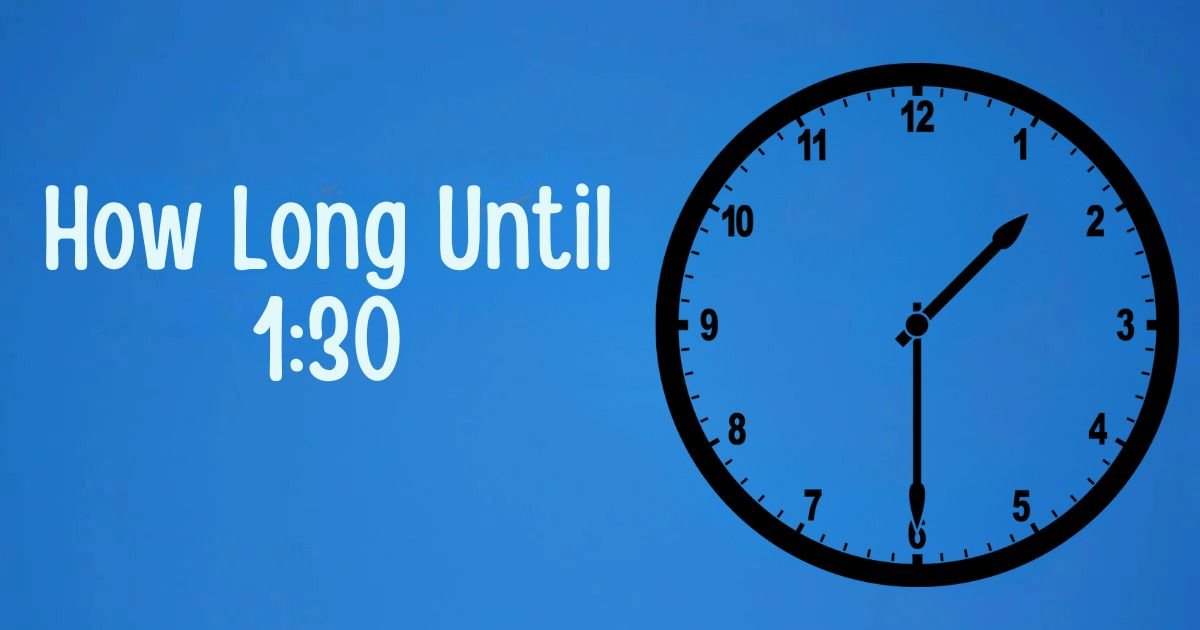
How Long Until 1:30? Quick Countdown and Time Math
The answer to how long until 1:30 is simple. Subtract your current time from 1:30. If it’s 12:00 PM, you have 1 hour and 30 minutes left. If it’s 12:45 PM, only 45 minutes remain.
This guide walks you through the math step by step. You’ll get tables for minutes, seconds, and decimal hours. It also covers midnight rollovers, U.S. time zones, and reminder habits that keep your day on track.
How Long Until 1:30 Right Now?
The time left depends on your current time and time zone. Find your clock reading in the table below. It assumes a target of 1:30 PM today.
| Current Time | Target Time | Time Remaining |
|---|---|---|
| 8:00 AM | 1:30 PM | 5 hours 30 minutes |
| 9:00 AM | 1:30 PM | 4 hours 30 minutes |
| 10:00 AM | 1:30 PM | 3 hours 30 minutes |
| 11:00 AM | 1:30 PM | 2 hours 30 minutes |
| 11:45 AM | 1:30 PM | 1 hour 45 minutes |
| 12:00 PM | 1:30 PM | 1 hour 30 minutes |
| 12:30 PM | 1:30 PM | 1 hour |
| 12:45 PM | 1:30 PM | 45 minutes |
| 1:00 PM | 1:30 PM | 30 minutes |
| 1:15 PM | 1:30 PM | 15 minutes |
| 2:00 PM | 1:30 PM tomorrow | 23 hours 30 minutes |
Watching for 1:30 AM instead? The math works the same way. At 10:00 PM, you have 3 hours and 30 minutes. At midnight, you have 1 hour and 30 minutes.
How to Calculate the Time Until 1:30
To find the time until 1:30, subtract the current time from 1:30 and borrow 60 minutes when needed. The method takes under a minute once you’ve tried it.
Follow these steps:
- Note your current time, such as 10:50 AM.
- Count the minutes to the next full hour. That’s 10 minutes.
- Count the full hours from there to 1:00 PM. That’s 2 hours.
- Add the final 30 minutes to reach 1:30 PM.
- Combine everything: 10 minutes plus 2 hours plus 30 minutes.
The total is 2 hours and 40 minutes.
Prefer a single number? Convert both times to minutes after midnight. Then subtract. Here, 1:30 PM equals 810 minutes, and 10:50 AM equals 650 minutes. The gap is 160 minutes, which matches the answer above.
Is It 1:30 AM or 1:30 PM?
Most people mean 1:30 PM, but context decides. Someone asking at lunchtime almost always wants the afternoon slot. Someone awake at midnight likely wants the overnight one.
Here’s a quick way to tell them apart. 1:30 PM falls in the early afternoon, right after the lunch hour. 1:30 AM falls deep in the night, long after most people are asleep.
Mixing these up causes real errors. A 12-hour slip can ruin a meeting, a flight check-in, or a medication schedule. Always write AM or PM next to the time. That tiny habit prevents most scheduling mix-ups.
What If It’s Already Past 1:30?
If 1:30 has already passed today, count to 1:30 tomorrow. Add 24 hours to the target, then subtract your current time.
Take a worked example. It’s 3:00 PM, and you want the next 1:30 PM. A full day from 3:00 PM is tomorrow at 3:00 PM. You need to stop 1 hour and 30 minutes short of that. The result is 22 hours and 30 minutes.
Here’s another. It’s 1:45 AM, and the target is 1:30 AM. You just missed it by 15 minutes. The next one arrives in 23 hours and 45 minutes.
How Many Minutes Until 1:30?
Multiply the remaining hours by 60, then add the leftover minutes. That gives you the total minutes until 1:30.
Try these quick examples, all aimed at 1:30 PM:
- From 12:00 PM: 1 hour 30 minutes equals 90 minutes.
- From 11:00 AM: 2 hours 30 minutes equals 150 minutes.
- From 12:45 PM: 45 minutes stays 45 minutes.
- From 10:10 AM: 3 hours 20 minutes equals 200 minutes.
Minutes work best for short tasks. If you have 45 minutes, you can plan a workout, a commute, or a solid work block. Hours feel vague by comparison.
How Many Seconds Until 1:30?
Multiply the total minutes by 60 to get the seconds until 1:30. Most people never need this number. Still, it’s handy for timers, coding projects, and classroom demos.
Using the same starting points:
- 90 minutes equals 5,400 seconds.
- 150 minutes equals 9,000 seconds.
- 45 minutes equals 2,700 seconds.
- 200 minutes equals 12,000 seconds.
Many countdown timers and stopwatch apps ask for seconds directly. Knowing this conversion saves you a trip to a calculator.
How Many Hours Until 1:30 in Decimal Form?
To get decimal hours, divide the leftover minutes by 60 and add them to the whole hours. One hour and 30 minutes is 1.5 hours, never 1.30.
| Current Time | Time Remaining | Decimal Hours |
|---|---|---|
| 9:00 AM | 4 hours 30 minutes | 4.5 |
| 10:10 AM | 3 hours 20 minutes | 3.33 |
| 11:30 AM | 2 hours | 2.0 |
| 12:00 PM | 1 hour 30 minutes | 1.5 |
| 12:15 PM | 1 hour 15 minutes | 1.25 |
| 12:45 PM | 45 minutes | 0.75 |
Watch out for the classic trap. Clock time runs on a base of 60. Decimals run on a base of 100. Payroll sheets and project trackers often need the decimal version, so the difference matters.
What Is 1:30 in 24-Hour Time?
In 24-hour time, 1:30 PM is 13:30, and 1:30 AM is 01:30. Military time drops the colon. That gives you 1330 and 0130.
The conversion rule is easy. For any PM hour from 1 to 11, add 12. For AM hours, keep the number and add a leading zero when needed.
Here’s a bonus fact. 1:30 PM sits 810 minutes after midnight. 1:30 AM sits just 90 minutes after midnight. Those numbers help when you calculate durations by hand.
How Do You Count Down Across Midnight?
To count across midnight, split the trip into two parts. Count to midnight first. Then count from midnight to your target.
Take a worked example. It’s 11:00 PM, and the target is 1:30 AM. You have 1 hour until midnight. Then you have 1 hour and 30 minutes more. The total is 2 hours and 30 minutes.
Now try the afternoon version. It’s 11:00 PM, and you want 1:30 PM the next day. One hour reaches midnight. Another 13 hours and 30 minutes reaches 1:30 PM. The total is 14 hours and 30 minutes.
The date flips at midnight. Forgetting that flip is the most common cause of overnight math errors.
How Long Until 1:30 in Different U.S. Time Zones?
The same moment lands on a different clock reading in each U.S. time zone. When it’s 1:30 PM Eastern, it’s 12:30 PM Central, 11:30 AM Mountain, and 10:30 AM Pacific.
That spread matters for calls and live events. A webinar at 1:30 PM ET starts three hours earlier on the West Coast. Always label the zone, such as “1:30 PM ET.”
Daylight saving time adds one more twist. Most of the U.S. moves clocks forward in March and back in November. On the night clocks fall back, 1:30 AM happens twice. The hour from 1:00 to 1:59 AM repeats. Countdown tools usually handle this automatically. Manual math does not.
Read More: How Long Until 3:30? AM or PM Guide
Countdown Tools vs. Traditional Clocks
A countdown tool shows the time left, while a regular clock only shows the current time. That difference saves mental effort, especially when stress is high.
| Feature | Traditional Clock | Countdown Tool |
|---|---|---|
| Shows time remaining | No | Yes |
| Needs manual math | Yes | No |
| Handles time zones | No | Often |
| Sends alerts | Rarely | Usually |
| Works offline | Yes | Depends on the app |
Phone timers, smart speakers, and web countdowns all work well. Pick the one you already use daily. A tool you’ll actually open beats a fancy one you’ll forget.
Practical Ways People Use a 1:30 Countdown
People use a 1:30 countdown for work deadlines, study blocks, and travel plans. The target sits right after lunch, which makes it a popular checkpoint.
Work and Meetings
A 1:30 PM meeting often follows a busy lunch window. Count back from the start time. Leave 10 minutes to review notes and 5 minutes to test your audio. You’ll walk in calm instead of rushed.
School and Study
Students often face a 1:30 PM class or exam. Use the countdown to split your review time into short blocks. Twenty-five minutes of focus, then a five-minute break, fits most schedules.
Travel and Appointments
Work backward from arrival time. Say your appointment starts at 1:30 PM. The drive takes 25 minutes. Parking takes 10 more. Add a 10-minute buffer. You should leave by 12:45 PM.
Smart Habits While You Wait
The best habit is to treat 1:30 as a finish line, not a starting gun. Plan to be ready 10 to 15 minutes early.
Build in a Buffer
Transitions eat time. Saving files, grabbing a jacket, and finding keys all add minutes. Count them in.
Batch Small Tasks
Short gaps suit short jobs. Answer a few emails or tidy your desk. Avoid starting anything big.
Stop Clock-Watching
Checking the time every two minutes makes the wait feel longer. Set one alert, then let it go. Your focus will thank you.
Why Waiting for 1:30 Feels So Long
Time feels slower when you watch the clock, because your brain counts every tick. The more you focus on the gap, the longer each minute seems. Distraction flips the effect. Busy minutes fly by.
That’s why a countdown helps. It turns vague waiting into a clear number. Once you know the gap is 40 minutes, you can fill it on purpose. A quiet project or a short walk beats staring at the wall. Try it once, and you’ll notice the difference.
How to Plan Your Schedule Before 1:30
Work backward from 1:30 and give each slot a single job. Start with the hard stop, then fill the gaps ahead of it.
Say you have 90 minutes before a 1:30 PM call. Spend 45 minutes on your main task. Use 20 minutes to prepare. Keep 15 minutes for lunch or a reset. That adds up to 80 minutes. The last 10 minutes stay free as your buffer.
A plan with slack survives surprises. A plan with none breaks at the first interruption.
How to Set a Reminder for 1:30
The fastest way to set a reminder is to use your phone’s clock app or a voice assistant. Both take seconds.
Follow these steps:
- Open the Clock app on your phone.
- Choose Alarm or Timer.
- Enter the target time, or the minutes remaining.
- Add a label such as “Leave for appointment.”
- Save it and check the volume.
For extra safety, set a second alert 15 minutes earlier. A 1:15 PM warning gives you room to wrap up. Calendar events with built-in notifications work well for recurring meetings too.
Common Mistakes When Calculating Time Until 1:30
Most errors come from five small slips. Each one is easy to avoid.
- Mixing up AM and PM. This causes 12-hour errors.
- Treating 60 minutes like 100. Remember that 1:30 means 90 minutes, not 130.
- Ignoring the date. Past 1:30 means tomorrow, not today.
- Forgetting time zones. A call at 1:30 PM Pacific isn’t 1:30 PM Eastern.
- Skipping the buffer. Real life runs slower than math.
Frequently Asked Questions
How long until 1:30 today?
Subtract your current time from 1:30. At 12:00 PM, you have 1 hour and 30 minutes. Check the quick-answer table above for other times.
How many minutes until 1:30 PM from noon?
There are 90 minutes from noon to 1:30 PM. That’s 1 hour and 30 minutes.
Is 1:30 in the afternoon?
1:30 PM is in the afternoon. 1:30 AM falls in the middle of the night.
How many hours until 1:30 PM from 9:00 AM?
You have 4.5 hours. That equals 4 hours and 30 minutes.
What is 1:30 PM in military time?
It’s 1330, or 13:30 with a colon. The AM version is 0130.
Conclusion
Finding how long until 1:30 takes one simple formula. Subtract the current time from 1:30, borrow 60 minutes when needed, and roll to tomorrow if the moment has passed. Convert the result into minutes, seconds, or decimal hours depending on your task.
For best results, pair the math with a reminder. Set an alert 15 minutes early and label the time zone. Do that, and 1:30 will never catch you off guard again.

Elena has 10 years of experience explaining time, countdowns, durations, time formats, and everyday scheduling questions.
One Comment