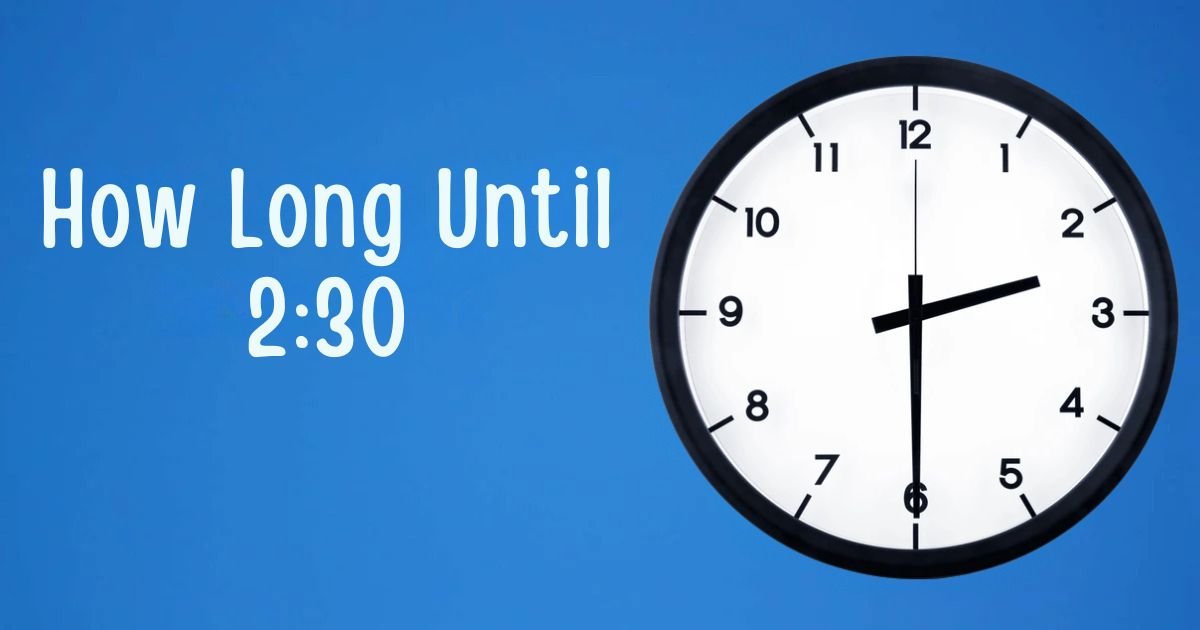
How Long Until 2:30? Easy Countdown to 2:30 PM
How long until 2:30 depends on the time it is right now. Subtract your current time from 2:30 PM to get your answer. If your clock reads 12:00 PM, you’re exactly 2 hours and 30 minutes away.
This guide breaks the math into simple steps. You’ll also get minute and second conversions, 24-hour clock help, next-day rules, time zone tips, and handy reminder ideas.
How Long Until 2:30 Right Now?
The answer depends on your local time and your time zone. The table below shows quick results for common start times, counting to 2:30 PM today.
| Current Time | Target Time | Time Remaining |
| 8:00 AM | 2:30 PM | 6 hours 30 minutes |
| 9:00 AM | 2:30 PM | 5 hours 30 minutes |
| 10:00 AM | 2:30 PM | 4 hours 30 minutes |
| 11:00 AM | 2:30 PM | 3 hours 30 minutes |
| 12:00 PM | 2:30 PM | 2 hours 30 minutes |
| 1:00 PM | 2:30 PM | 1 hour 30 minutes |
| 2:00 PM | 2:30 PM | 30 minutes |
| 2:15 PM | 2:30 PM | 15 minutes |
| 3:00 PM | 2:30 PM tomorrow | 23 hours 30 minutes |
| 6:00 PM | 2:30 PM tomorrow | 20 hours 30 minutes |
Find your current time in the first column. Anything after 2:30 PM rolls into tomorrow. A live countdown timer gives second-by-second precision, but this table works well for a fast check.
How to Calculate the Time Until 2:30
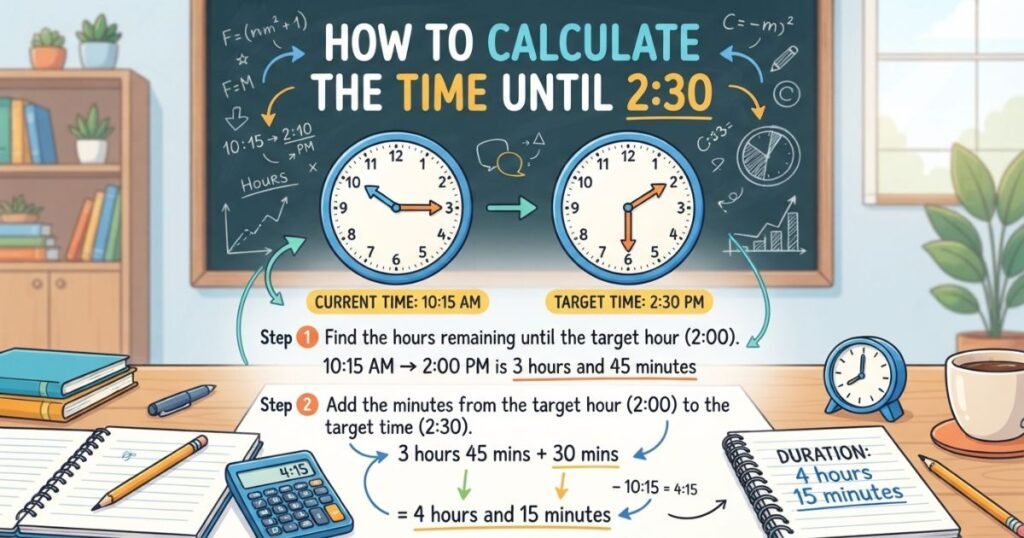
To find how long until 2:30 PM, subtract the current time from 2:30 PM. It’s basic subtraction with one twist. Minutes run out at 60, not 100.
Follow these steps:
- Write both times in the same format. The 24-hour clock is easiest, so 2:30 PM becomes 14:30.
- Subtract the hours first.
- Subtract the minutes next.
- If the minutes go negative, borrow one hour and add 60 minutes.
- Combine the hours and minutes left over.
Here’s a worked example. Say it’s 10:45 AM. Borrow an hour, so 14:30 turns into 13:90. Now subtract 10:45 from 13:90. You get 3 hours and 45 minutes.
Prefer counting up? Try the chunk method. From 10:45 to 11:00 is 15 minutes. From 11:00 to 2:30 PM is 3 hours and 30 minutes. Add them together and you land on 3 hours and 45 minutes again. One more test. At 1:50 PM, subtract 13:50 from 14:30. The gap is 40 minutes.
What If It Is Already Past 2:30?
If 2:30 PM has passed today, you’re counting down to 2:30 PM tomorrow. Take the time that has passed since 2:30 and subtract it from 24 hours.
Try it at 3:00 PM. Thirty minutes have passed since 2:30. So 24 hours minus 30 minutes leaves 23 hours and 30 minutes.
Now try 6:45 PM. Four hours and 15 minutes have gone by. That leaves 19 hours and 45 minutes until the next 2:30 PM. The same rule works for any target time. Only the numbers change.
How Long Until 2:30 Tomorrow?
To find the wait until 2:30 PM tomorrow, add 24 hours to today’s result. This works when 2:30 PM hasn’t happened yet.
At 12:00 PM, today’s wait is 2 hours 30 minutes. Add 24 hours and you get 26 hours 30 minutes. At 9:00 AM, the total is 29 hours 30 minutes. Planning a trip or a big launch? This math helps you set clear expectations for the day after.
How Many Minutes Until 2:30?
There are 870 minutes between midnight and 2:30 PM. That’s 14 hours times 60, plus 30 more. To get the minutes remaining, convert your current time into minutes after midnight. Then subtract that number from 870.
At 12:00 PM, you’re at 720 minutes. So 870 minus 720 gives you 150 minutes. At 11:15 AM, you’re at 675 minutes. That leaves 195 minutes, or 3 hours and 15 minutes. A shortcut helps too. Multiply the remaining hours by 60, then add the leftover minutes.
How Many Seconds Until 2:30?
Multiply the minutes remaining by 60 to get seconds. One minute holds 60 seconds, and one hour holds 3,600. From 12:00 PM, 150 minutes equals 9,000 seconds. From 11:15 AM, 195 minutes equals 11,700 seconds.
Most people never need this level of detail. Still, seconds matter for online sales drops, exam timers, live event starts, and broadcast schedules.
How Many Hours Until 2:30?
The hours until 2:30 PM equal your time remaining, shown as hours and minutes or as a decimal. Decimals help with payroll, billing, and spreadsheets.
| Time Now | Time Remaining | Decimal Hours |
| 9:00 AM | 5 hours 30 minutes | 5.5 |
| 10:15 AM | 4 hours 15 minutes | 4.25 |
| 11:45 AM | 2 hours 45 minutes | 2.75 |
| 12:30 PM | 2 hours | 2.0 |
| 1:10 PM | 1 hour 20 minutes | 1.33 |
| 1:45 PM | 45 minutes | 0.75 |
Watch out for one trap. An hour and a half is 1.5 hours, not 1.30. Divide the extra minutes by 60 to convert them.
What Is 2:30 PM in 24-Hour Time?
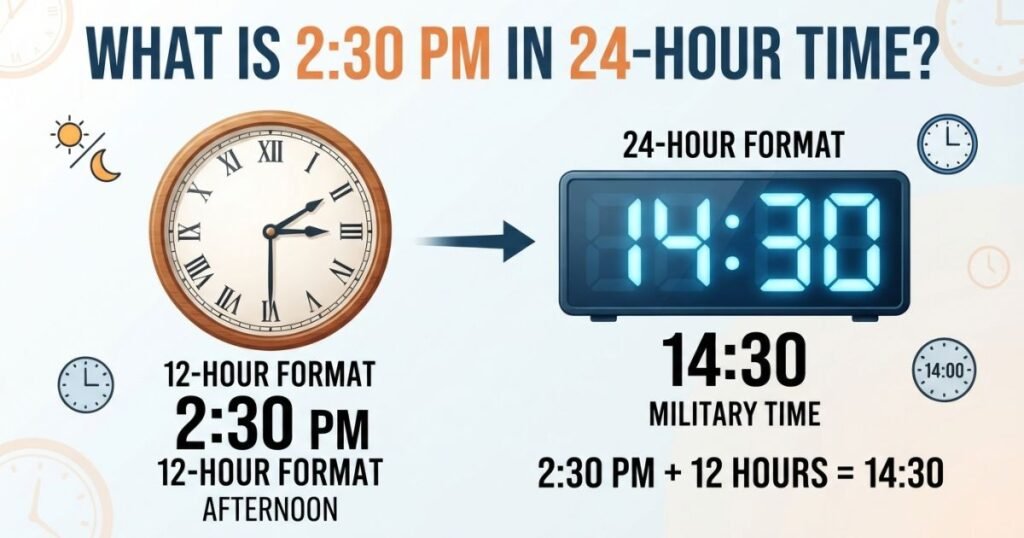
2:30 PM is 14:30 in 24-hour time. Many people say “fourteen thirty,” and the military writes it as 1430. The rule is simple. Add 12 to any PM hour, except 12 PM, which stays 12. Minutes never change. The morning version, 2:30 AM, reads 02:30 or 0230. It sits 150 minutes after midnight.
How Long Until 2:30 AM?
Counting to 2:30 AM works the same way, but the target sits only 150 minutes after midnight. Overnight math is quick once you know the pattern.
Here are a few overnight checks:
- At 10:00 PM, you wait 4 hours 30 minutes.
- At 11:00 PM, you wait 3 hours 30 minutes.
- At 12:00 AM, you wait 2 hours 30 minutes.
- At 1:00 AM, you wait 1 hour 30 minutes.
Daylight saving time adds a twist. On the night clocks spring forward, most US time zones skip from 2:00 AM straight to 3:00 AM. So 2:30 AM doesn’t exist that night.
How Long Until 2:30 in Your Time Zone?
The answer changes by zone, so always name yours. When it’s 2:30 PM Eastern, it’s 1:30 PM Central.
| Time Zone | Local Time When It’s 2:30 PM Eastern |
| Eastern (ET) | 2:30 PM |
| Central (CT) | 1:30 PM |
| Mountain (MT) | 12:30 PM |
| Pacific (PT) | 11:30 AM |
Most of the US moves clocks forward on the second Sunday in March. Clocks go back on the first Sunday in November. Most of Arizona skips this change, so its gap with neighboring zones shifts twice a year.
Write events with a zone label, like “2:30 PM ET.” That one habit prevents missed calls and confused guests.
How to Calculate a Countdown Across Midnight
Add the hours left until midnight to the hours after midnight. Then total both pieces. Say it’s 11:00 PM, and your target is 2:30 PM tomorrow.
One hour remains until midnight. Then 14 hours and 30 minutes pass before 2:30 PM. The total is 15 hours and 30 minutes. For a 2:30 AM target from 11:00 PM, the total is 3 hours and 30 minutes.
Read More: How Long Until 11 PM? Quick Ways to Count the Time
Common Ways People Use a 2:30 Countdown
People count down to 2:30 for meetings, classes, travel, and daily routines. It’s a common afternoon anchor point.
Work and Business Deadlines
A 2:30 PM deadline often means a meeting start or a submission cutoff. A countdown shows whether you’ve got time for one more task. Block the final 15 minutes for review.
School and Study
Many students watch the clock near 2:30 PM, since some school days end around then. Exam takers also use countdowns to pace each section and avoid rushing the last questions.
Travel and Appointments
For a 2:30 PM appointment, work backward from your arrival time. Subtract the drive and a 10-minute buffer. If the drive takes 40 minutes, leave by 1:40 PM at the latest.
Using a Calendar and Countdown Together
A calendar shows what’s planned, while a countdown shows how close it is. Using both keeps you organized and calm.
Add the 2:30 event to your calendar first. Then start a countdown when the day gets busy. The calendar holds the plan, and the countdown protects it.
The Psychology Behind Waiting for 2:30
Watching the clock makes waiting feel longer. Many people report an energy dip in the early afternoon, so a clear endpoint like 2:30 can give the hours some shape.
A countdown turns vague waiting into a measurable task. You know the finish line, so your brain can relax.
Why Checking the Clock Over and Over Doesn’t Help
Repeated checking breaks your focus. Each glance costs a few seconds, and refocusing costs even more. One alert or one countdown frees your attention for real work.
Productivity Tips While Counting Down
Use the time before 2:30 in focused blocks instead of just waiting. A little structure goes a long way.
Pick a Short Task List
Choose two or three small jobs that fit inside your window. Answer emails, tidy a file, or prep notes for the meeting.
Work in 15-Minute Blocks
A 2 hour 30 minute window holds ten 15-minute blocks. Give each block one job. Small wins build momentum fast.
Leave a Buffer
Stop 10 minutes early. You’ll need time to grab water, open the meeting link, or find a parking spot.
Countdown Tools vs. Traditional Clocks
A countdown tool shows time remaining. A traditional clock shows only the current time.
| Feature | Traditional Clock | Countdown Tool |
| Shows time remaining | No | Yes |
| Needs mental math | Yes | No |
| Sends alerts | Rarely | Usually |
| Time zone handling | Manual | Often automatic |
| Best use | Checking the hour | Beating a deadline |
Phone timers, calendar alerts, and smart speakers all offer countdown features. Pick one you already use every day.
Countdown Apps for Work and Personal Tasks
Countdown apps suit anyone who juggles tasks across the day. Teams use them to signal a meeting start or a shared deadline. At home, they help with cooking times, study sprints, and school pickups.
Look for apps with repeating alerts, custom labels, and time zone support. Those three features solve most timing headaches.
How to Plan Your Schedule Before 2:30
Work backward from 2:30 and give each block a clear job. Say it’s 11:30 AM, which leaves exactly 3 hours. A plan might look like this:
- 11:30 AM to 12:00 PM: finish your main task.
- 12:00 PM to 1:00 PM: take lunch.
- 1:00 PM to 2:15 PM: focus on prep work.
- 2:15 PM to 2:30 PM: review and get ready.
That schedule leaves no gaps and no scramble.
How to Set a Reminder for 2:30
Set your first alert 15 minutes before 2:30 so you have time to wrap up. Here’s how:
- Open your phone’s clock or calendar app.
- Create an event at 2:30 PM and name it clearly.
- Add the time zone if you work across regions.
- Set the first alert for 2:15 PM.
- Add a second alert at 2:25 PM.
Test the alert once. A silent phone can undo the best plan.
Common Mistakes When Calculating How Long Until 2:30
Most errors come from four habits: AM and PM mix-ups, decimal confusion, date rollover, and time zone slips.
- Mixing up AM and PM. 2:30 AM and 2:30 PM sit 12 hours apart.
- Treating minutes like decimals. 1 hour 30 minutes is 1.5 hours, not 1.30.
- Ignoring the date. Any time after 2:30 PM points to tomorrow.
- Forgetting time zones. A call at 2:30 PM in New York isn’t 2:30 PM in Denver.
Frequently Asked Questions
How long until 2:30 PM today?
Subtract your current time from 14:30. At noon, the wait is 2 hours and 30 minutes.
How many minutes until 2:30 PM?
Subtract your current minutes after midnight from 870. At 12:00 PM, that’s 150 minutes.
Is 2:30 in the afternoon?
Yes, 2:30 PM falls in the early afternoon. 2:30 AM belongs to the middle of the night.
How many hours before 2:30 PM is 9:00 AM?
9:00 AM sits 5.5 hours before 2:30 PM. That’s 5 hours and 30 minutes.
What is 2:30 PM in military time?
It’s 1430, read aloud as “fourteen thirty.”
Conclusion
The formula for how long until 2:30 is simple. Subtract your current time from 2:30 PM. If that time has passed, count to tomorrow and add 24 hours.
Keep the key numbers handy: 14:30, 870 minutes, and 9,000 seconds from noon. Then set a reminder so the clock never catches you off guard.

Elena has 10 years of experience explaining time, countdowns, durations, time formats, and everyday scheduling questions.